Zigzag Beach
Audio description Image
Audio description Diagram
Transcript
Audio description Image
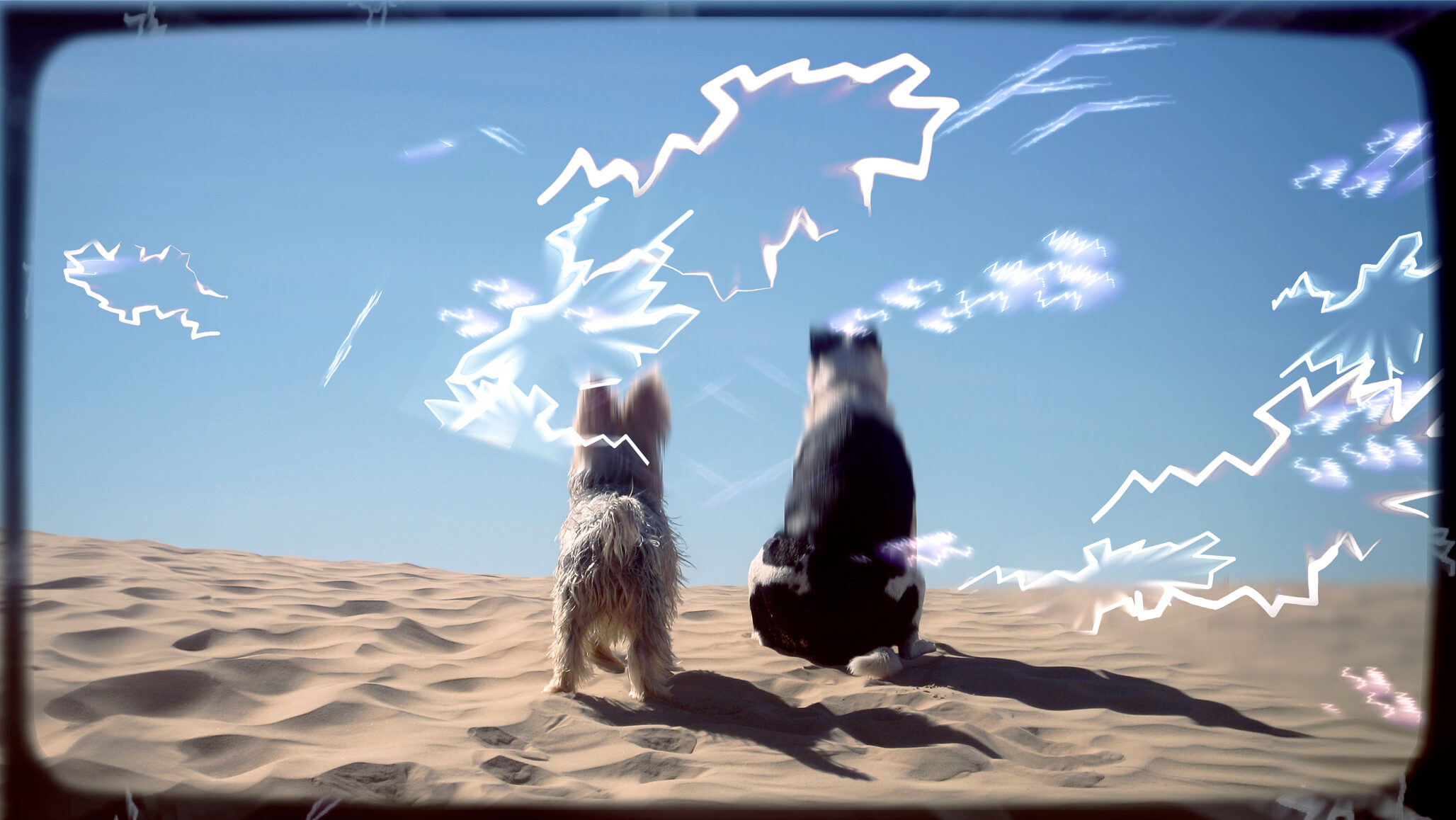
Audio Description for Zigzag Beach, 2025, Video Still co-created by Participant Sixty, Pam, and Victoria Hamilton, Chromaluxe print on HD Metal, 25 x 45cm.
The artwork titled ‘Zigzag Beach’ is an unframed print created between 2024 – 2025. It measures 45 cm width and 25 cm high and is a Chromaluxe print on HD Metal – a method chosen to echo the clarity, depth, and vividness of the experience of a Charles Bonnet Vision.
The image features two dogs, one white, the other black and white, are on a beach landscape with a bright blue sky. Positioned at the bottom centre, they occupy about one sixth of the image space. Both dogs face away from the viewer, looking ahead. The small white dog on the left, fluffy and scruffy, is standing on all four legs, appears to have just been for a swim. The black and white dog on the right, though sitting, is still taller than the white dog, indicating a medium sized breed. Their shadows stretch nearly to the edge of the image. The light beige beach sand forms a horizontal plane just below mid-level suggesting they are near the top of an incline.
Across the image is an invisible large triangle, or spear shape, going from bottom right corner, to mid left side, to top right corner. The triangle spear shape is indicated blurring the background sand and the parts of the dogs that are within it, and numerous white zigzag, zippy markings. It takes up over fifty percent of the image space. Bright, white, zigzag markings – numbering 60 to 100 – are most noticeable within the triangle area. Some appear close while others are faded into the distance. Almost all are in pairs of some kind either mirrored or connected and floating in space.
Overall, this image is a sunny beach scene with two dogs looking out across the beach with a spear-shaped foreground and numerous bright zigzag lights. Participant Sixty, Pam, lives in Adelaide, Australia. This image is a still from a one-minute-and nineteen-second video created for the Visions of Charles Bonnet Syndrome research by Victoria Hamilton.
Audio description Diagram
Audio Description for Zigzag Beach diagrams, 2025, created by Victoria Hamilton, in Adobe Illustrator, 40 x 10cm.
The diagram is titled ‘Zigzag Beach: the vision of Participant Sixty | Pam. It is a diagram created between 2023 – 2025. It measures 40 cm width and 10 cm high and is a multicoloured print on self-adhesive material, chosen for its clarity in gallery settings and ease of installation.
On the left end of the image, a black-and-white QR code enclosed in a square with chamfered corners spans the full height. Further across the top, the title ‘Zigzag Beach, appears centrally placed in large bold black text. To the right edge is ‘the vision of Participant Sixty | Pam (please note some of the participants in this research have chosen to disclose their identity). Beneath, a sentence reads: “video still co-created by Participant Sixty, Pam, and Victoria Hamilton.” Below this top line of text, stretching from the QR code to the image’s right edge, is a line of four coloured shapes: a light brown dotted circle, grey rectangle with curved corners, a light blue dotted circle, and a pink circle. These shapes are connected by a thin white line running behind them.
The light brown dotted circle features a title arc of text reading: Action taken on having CBS vision. Across the middle is written: garden respite CBS hallucinations as tiring and annoying acknowledges that their CBS hallucinations can be exhausting and frustrating to deal with. The grey rectangle with curved corners contains a world map with small coloured placemarks indicating participants origins. A light blue fuzzy circle is located over the South Australian region of the world. Next is a smaller light blue dotted circle containing with text reading: Focus group 1: sight loss – glaucoma. The final diagram is a larger green circle depicting the field of view representing areas of vision loss. Participant Sixty’s diagram shows loss of vision from both left and right eyes.
The overall information represents a participant from South Australia who has loss of vision from glaucoma and reports the experience of CBS as exhausting at times with garden respite a recommended technique.