Dingo Bedroom
Audio description Image
Audio description Diagram
Transcript
Audio description Image
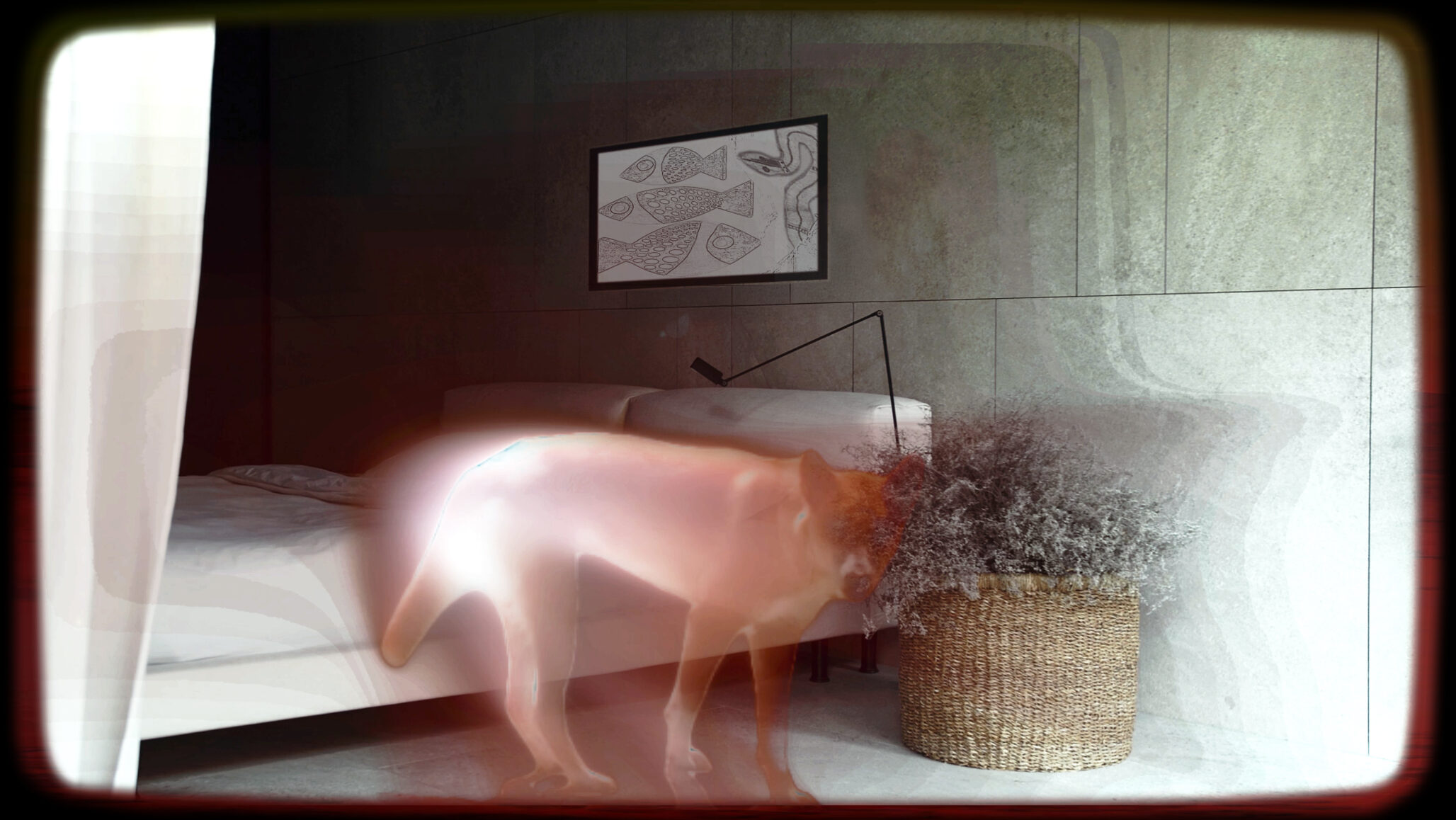
Audio Description for Dingo Bedroom, 2025, Video Still co-created by Participant Thirty-nine, Nalda, and Victoria Hamilton, Chromaluxe print on HD Metal, 25 x 45cm.
The artwork titled ‘Dingo Bedroom’ is an unframed print created between 2024 – 2025. It measures 45 cm width and 25 cm high and is a Chromaluxe print on HD Metal – a method chosen to echo the clarity, depth, and vividness of the experience of a Charles Bonnet Vision.
The artwork features a slightly out-of-focus image of a dingo in a bedroom. The scene includes a bed and a plant in a basket, dominated by the earthy orange, translucent figure of the dingo in motion. Positioned centrally in the lower section, the dingo’s body, head, and tail are recognisable, but indistinct due to a glowing white light emanating from its lower half. The animals limbs are stretched out as if in motion, with its gaze fixed straight ahead.
A white curtain hangs along the left edge stretching from top to bottom acting as a framing device that contrasts with the dark shadows behind it. On the right, a third into the image, is a large seagrass basket filled with a small-leafed pot plant. The bedroom wall recedes from right to left constructed from a light grey material like stained ply or tiles. This minimalist atmosphere is enhanced by a small angled lamp next to the bed on the right and a mid-sized painting hanging above. The painting features three large fish and a large snake created in a black and white graphic style with a black simple frame. The foot of the bed begins in the bottom left and rises diagonally to the centre. It is an off-white double bed with padded headboard that is covered by an off-white doona. The right side of the image is gently lit with light grey tones while the top left quarter is in deep shadow adding depth to the space.
Overall, the impression is somewhat hazy and indistinct highlighting the ethereal presence of the dingo. Participant Thirty Nine lives in Perth, Australia. This image is a still from a 48 second video created for the Visions of Charles Bonnet Syndrome research by Victoria Hamilton.
Audio description Diagram
Audio Description for Dingo Bedroom diagrams, 2025, created by Victoria Hamilton, in Adobe Illustrator, 40 x 10cm.
The diagram is titled ‘Dingo Bedroom: the vision of Participant Thirty-nine | Nalda. It is a diagram created between 2023 – 2025. It measures 40 cm width and 10 cm high and is a multicoloured print on self-adhesive material, chosen for its clarity in gallery settings and ease of installation.
On the left end of the image, a black-and-white QR code enclosed in a square with chamfered corners spans the full height. Further across the top, the title ‘Dingo Bedroom’, appears centrally placed in large bold black text. To the right edge is ‘the vision of Participant Thirty-nine, Nalda, (please note some of the participants in this research have chosen to disclose their identity). Beneath, a sentence reads: “video still co-created by Participant Thirty-nine, Nalda, and Victoria Hamilton.” Below this top line of text, stretching from the QR code to the image’s right edge, is a line of four coloured shapes: a dark pink dotted circle, grey rectangle with curved corners, a brown dotted circle, and a pink circle. These shapes are connected by a thin white line running behind them.
The dark pink dotted circle features a title arc of text reading: Action taken on having CBS vision. Across the middle is written: often trying to make them disappear by shouting or opening their eyes. I say get out – go away. The grey rectangle with curved corners contains a world map with small coloured placemarks indicating participants origins. A light blue fuzzy circle is located over the Western Australian region of the world. Next is a smaller brown dotted circle containing text reading: Focus group 4: sight loss – “ I’ve got glaucoma. I’ve had it for about 10 years.” The final diagram is a larger pink dotted circle with a diagram depicting a field of view representing areas of vision loss. Participant Thirty-nine’s diagram shows loss of vision around the edges.
The overall information represents a participant from Western Australia who has extensive sight loss from glaucoma and takes and active approach towards the CBS visions.